Friday, December 4, 2015


  SANTA CRUZ LONG-TOED SALAMANDER
( Ambystoma macrodactylum croceum )
BY: Armando Pulido
 
http://www.californiaherps.com/salamanders/images/amcroceum.jpg

Description and Ecology

The long-toed salamander is a member of the mole salamander family ( Ambystomatidae ) which is characterized by its mottled black, brown, and yellow pigmentation, and its long outer fourth toe on the hind limbs. The ventral also know as its stomach has a surface that is sooty black. In order for the salamander to facilitate swimming it has a tail that is flattened from side to side. Adults have an average length from snout-to-vent length of 1.7 to 2.8 inches. They weigh approximately .1 to .4 ounces. When they are young, larvae have broad heads, three pairs of bushy gills and broad caudal fins that extend well onto the back. This salamander has two distinct life phases, it is first larvae that hatch from eggs laid in the water. After they hatch, they swim using their enlarged tail fin and breathe with filamentous external gills. They then transform into four -legged salamanders. After they become salamanders, they become terrestrial and breath with lungs. This species is found mostly found under wood, logs, rocks, and bark and other objects near breeding sites. The average adult lives to be about 10 years of age. This salamander is a carnivore when it is an adult. They eat small invertebrates such as worms, mollusks, insects, and spiders. In order to protect itself from predators, adults use their sticky skin secretions to deter predators. They can also vocalize with squeaks and clicks which can scare off predators. In terms of there breeding, reproduction is aquatic, adults become sexually mature at 1-3 years. Over night the male salamander will migrate overland during the heavy rain from October through February. The breeding process occurs in January and February. The way it works is that males enter the ponds first and wait for the females for several days up to a month. After the breeding process occurs females lay from 90-400 eggs in clusters. This clusters contain 1-81 eggs in shallow water that attach them singly or in loose clusters to the undersides of logs and branches. Eggs then hatch in 2-5 weeks. 

Geographic and Population Changes 

Since the Santa Cruz Long-toed Salamander is endemic to California, it has a a limited range of scattered populations in a reported 11 locations around the coast of Monterrey Bay in southern Santa Cruz counter and the northern edge of Monterey county. In December 2, 1954 at Valencia Lagoon, Rio del Mar, Santa Cruz county, this breeding pond was reduced in size by a highway construction along California State Highway. In 1969 this highway was converted into a freeway and it eliminated the Valencia Lagoon, which was a breeding pond for the salamanders. Around the same period of time another breeding pond was threatened by a proposed mobile home park which eventually made the salamander by listed as endangered.

Today only 23 populations of the salamander are known to exist. According to the recovery plan it is said that the Santa Cruz long-toed salamander has a distribution of three metapopulations, each with one or more subpopulations. These populations inhabit one or more ponds or sloughs and the surrounding upland habitats. Out of all the larvae, only 5 percent survive to metamorphosis. The other 95% of the population does not finish the race to metamorphose or is eaten by fish, birds or diving beetles. 

In the figure below, this is the current distribution of the Santa Cruz long-toed salamander in Santa Cruz and Monterey.
http://www.californiaherps.com/salamanders/images/amcroceum.jpg


Listing Date and Type of Listing

As previously stated above, the construction of the California State Highway 1 caused destruction of the salamander habitat. Not only did this event harm the population of the salamander but the mobile home park also caused damages to another breeding pond. (Ellicott Slough) After these two events happened, the U.S. Fish and Wildlife service and the California Fish and Game Commission listed the Santa Cruz Long-Toed Salamander as an endangered species in March 1967. Other factors that contributed to this is the fact that this salamander has a limited distribution.  

In the figure below, it shows the freeway which caused the salamander to be endangered. 
State Highway Junction Route CA-17 Southbound Santa Cruz Freeway approaching 1/2 mile to Exit 1B - State Highway Junction Route CA-1 Cabrillo Highway SOUTH Watsonville - Monterey next right exit followed by Exit 1A - State Highway Junction Route CA-1
https://www.flickr.com/photos/raymondyue/5583406075/player/f2645c9b97
Main Threats 

Over the last 10,000 to 12,000 years climate and geologic activities have created the restricted and patchy distribution of habitats suitable for the Santa Cruz long-toed salamanders, resulting in a naturally restricted distribution of the subspecies. This disjointed distribution of the subpopulations have made the salamander susceptible to populations declines which are both human-associated and natural factors. Some factors include habitat loss and degradation, collection, predation by introduced and native organisms,infestation of parasites, geologic processes, and weather conditions. In Santa Cruz County and Monterey County, the main cause for this factors have been road construction and urbanization. 

The figure below shows threats to the stability and persistence of Santa Cruz long-toed salamanders.
https://www.flickr.com/photos/raymondyue/5583406075/player/f2645c9b97
In 1954 is when the Santa Cruz long-toed salamander was discovered. Before the discovery of this salamander, Valencia Lagoon was being farmed when seasonally dry. Not only did this affect the lagoon but in less than a year after the discovery of the only know breeding pond, highway construction took place and the lagoon size was then reduced to half of its size. This really affected the salamander because it was unable to reproduce. As a result of destroying their habitat of an endangered species, Caltrans constructed an artificial pond.  As a matter of fact multiple ponds were constructed to help the redevelopment of this species. This habitats created by humans allowed the salamander to survive. 

Recovery Plan

Listed below are the steps essential to the recovery plan part 1:

1. Having self-sustaining populations of Santa Cruz long-toed salamanders at Valencia-Seascape, Larkins Valley, Ellicott-Buena Vista, and human-related mortality, and monitoring population;
2. Another step that can help is to find different breeding sites and suitable upland habitat areas.
3. The planning and implementing appropriate management strategies of the population status of Santa Cruz long-toed salamanders in the Merk Road drainage, in upper Moro Cojo Slough, and at any other new location found through the surveys. 
4. Having the appropriate research to support the management of the Santa Cruz long-toed salamander habitats and populations. 
5. Having the support of the public for this salamander through expanding public education and information.
The first objective is to recover the Santa Cruz long-toed salamander. The second part of the recovery plan is to recover the species to warrant delisting. 

Listed below are the steps for the recovery plan part 2:

1. The first step is to have self-sustaining population, make sure that existing ponds remain, or become, functional breeding sites, improve the Valencia Lagoon, maintain the seascape pond at an appropriate level, come up with a comprehensive management plan for the Calabasas pond, continue adaptive management at Ellicott pond, working with the community to continue to have the breeding sites and upland habitats, putting out the effort to conserve Buena vista pond site, monitoring and managing Santa Cruz long-toed salamanders and their habitat at McClusky Slough, establish management actions at Moro Cojo Slough.
2. The management of upland habitats to provide adequate cover and food for nonbreeding salamanders, protect salamander habitat in Santa Cruz County, make sure that Salamander protection zone reguations are enforced, continue upland habitat restoration in sites, work with Willow Canyon Enterprise to come up with adequate Habitat conservation plan.
3. Build new ponds or restore existing ponds, analyze the possibility of establishing additional ponds in Larkins valley or other suitable places.
4. Reduce human-related mortality. prevent losses to the populations, create protection zones in Santa Cruz County, reduce the population of predators such as raccoons, opossums, and skunks.
5. Conduct surveys and identify habitat for protection.
6. Have the proper management for populations in the Merk Road and upper Moro Cojo.
7. Conduct research to habitat management such as to the determine the effects of methoprene, effects of mosauitofish/larval salamander interactions etc.
8. Have public education and information programs.  

Personal Action:

There are many things one can do to help the preservation of the Santa Cruz long-toed salamander. Recycling is one easy way because it reduces your environmental impact. It eliminates waste that can be later dumped in environments where endangered species live such as the salamander. If you happen to live in the local areas to where these salamanders live, a good way to help them is by simply volunteering to pick up waste in their habitats. Another good way one can help with the preservation of the salamander is by buying land where these salamanders live and help preserve their habitat. 
Image result for picking up waste

http://www.calhouncounty.org/recycle/wastetotals.html

Works cited


http://ecos.fws.gov/docs/recovery_plan/990702.pdf

"Find Endangered Species." Endangered Species. N.p., n.d. Web. 07 Dec. 2015.          <http://www.fws.gov/endangered/>.

"Santa Cruz Long-toed Salamander - Ambystoma Macrodactylum Croceum." Santa Cruz Long-toed Salamander. N.p., n.d. Web. 07 Dec. 2015. <http://www.californiaherps.com/salamanders/pages/a.m.croceum.html>.


The Red Wolf by Courtney Petrella

Courtney Petrella BIO 227
 https://biodiversitywarriors.wikispaces.com/Red+Wolf


The Red Wolf  "Canis Rufus”
One of the World’s Most Endangered Wild Canids

When brainstorming a list of endangered species, many people may remember the infamous story of the recovery of the gray wolf in Yosemite National Park; however, most people don’t know that the red wolf, the only other wolf species that resides in North America is also critically endangered. Like most gray wolves and coyotes, red wolves weigh 45-80 lb. and stand approximately 26 in. at the shoulder. They are social animals that live in packs and are most
The red region displays where a small population of red wolves
currently reside. 
(http://www.fws.gov/redwolf/aboutrecovery.html)
active during dusk and dawn to avoid human interaction. The red wolf can be distinguished from other wolves by its reddish colored fur, hence their name. Red wolves also tends to prey on raccoons, rabbits, white-tailed deer, and other rodents. Most importantly, the red wolf’s population is at a much higher risk of extinction than other wolves, with only about 50 individuals living in the wild in the eastern North Carolina region.
page1image14800

The Howl for Help
The descriptions of wolves across North America were first documented in the early 1500’s. At that time, it was believed that all the wolves in North America, although with different characteristics, were all from the same species. It wasn’t until 1851 that Audubon and Bachman suggested that the wolf that occupied he southern states was in fact an entirely different species than those of the north. The red wolf, unlike the gray wolf and coyote, adapted to the southeastern United States.


Red Wolf Howl
 
(http://www.whitewolfpack.com/ 2013_11_01_archive.html)
Unfortunately, the red wolf was exterminated from most of its range in the early part of the century, leaving behind very few clues for scientists to put together to describe its life history. Research has shown that red wolves thrive in habitats similar to agricultural lands, which supports the belief that red wolves caused widespread cattle losses that led to extensive predator control programs during that time. However, they are can habituate many forests and wetlands, which suggests that in regards to habitat they are generalists and able to adapt to most setting that a prey species populates. Fear and misunderstanding of the animals led to killing for bounties. The red wolf was also affected by forest habitat destruction by land clearing and drainage projects, logging, mineral exploration, and road development.

Interbreeding with the coyote (an exotic species not native to North Carolina) has been recognized as the most significant and detrimental threat affecting recovery of red wolves in their native habitat. Currently, adaptive management efforts are attempting to
Graph displaying the importance of multiple founders
to promote genetic diversity. 
(http://ecos.fws.gov/docs/recovery_plan/901026.pdf)
reduce the threat of coyotes while building the wild red wolf population. Coyotes were almost unheard of in the North Carolina region until the 1990s, when many populations established themselves. The IUCN’s description of the red wolf mentions, “it has been estimated that the red wolf population in North Carolina can only sustain one hybrid litter out of every 59 to maintain 90% of its genetic diversity for the next 100 years.” 

If the hybridization rates of 1999 continued at the same level, the red wolf species could disappear in 3-6 generations. 

Without hybridization, the full recovery of the red wolf is completely possible; therefore, reducing the number of coyotes to prevent hybridization is the main focus of the Red Wolf Recovery Team at this time.

Protection for the Pack

A pack of Red Wolves
(
http://www.glogster.com/erincr/ red-wolf-project/ g-6lu0sguv915bonul9aj04a0)


The red wolf was one of the first species to gain the attention of the US Fish & Wildlife Service after it passed the Endangered Act in 1973. A small recovery team was assigned to the species in August 4, 1974 to protect the species until it was officially listed as endangered in January of 1975. After documenting that the species was truly declining and studying the red wolf’s basic ecology and natural history, it was apparent that the only glimmer of hope for the species’s survival was to catch as many individuals and start a captive-breeding program in order to steadily increase the population. In 1980, the red wolf population went completely extinct in the wild, with the only remaining individuals in captivity. The red wolf has also been on the IUCN Red List as “endangered” since 1982 and “critically endangered” from 1996 until now. The ESA and IUCN are now taking significant steps to reduce the major threats to the red wolf population and bolster their success in the wild.

Rufus to Recovery
The US Fish & Wildlife Service drafted a recovery strategy for the red wolf species. The overall goal of the plan was to create distinct populations of red wolves, through reintroducing wolves that were born as a part of an intensive captive breeding program, that are capable of enduring nature’s evolutionary processes. This goal is similar to almost all recovering populations in that they are self-sustaining with as little of human interaction as possible.

The objectives defined in the recovery strategy specific to red wolves were:
1. To preserve 80 to 90 percent of genetic diversity of the species in 150 years.
2. To remove those threats that have the potential to bring about extinction of the species (Approx. 220 animals in the wild and 330 in captivity).
3. To maintain the red wolf in perpetuity through cryogenic preservation of super and embryo banking.


Graph that shows the distribution of males and females in 1989. 
(http://ecos.fws.gov/docs/recovery_plan/901026.pdf)
The ESA’s recovery strategy then goes into depth about each aspect of the plan and a schedule of when each step should be implemented in order to save the red wolf population.

page4image9072
To begin, the ESA noticed the need for a full-time coordinator designated specifically to the red wolf population that “provides leadership, establishes annual objectives and goals, develops budgetary needs, and serves as a spokesperson of the program. This coordinator would also be the manager of a Red Wolf Recovery Team, composed of individuals with specific education and training to carry out the recovery plan.
http://sisterofthewolves.tumblr.com/post/
55779340561/picture-source-differences- between-gray-wolves

To reintroduce the wolves bred in captivity, the ESA proposed reestablishing three or more wild populations of about 70 individuals each within their historic range. The first step of this aspect would be to define where these reintroduction sites will be and develop a list in order of the most suitable for the species. The team would then need to go in priority order and examine these potential sites for the essential needs of red wolves, as well as the outside factors, such as the proximity to towns and communities. A poll of the community members would need to measure how the general pubic will respond to a reintroduction site in the area. The team would also need to research and experiment with the canid interactions the wolves may have, such as coyotes or dogs. The plan includes releasing red wolves near coyote populations in the area and studying their movements and interactions. Coyotes are one of the main threats to the recovery of the red wolf because they hybridize together, which limits the stability of the red wolf’s genetic diversity. As pictured, the two species are incredibly similar, but their offspring are known to enter human habitat, acting problematic and violent.

The priority list will then need to be updated with the new information about each site. Beginning with the most suitable sites, the Red Wolf Recovery Team will begin coordinating with the local officials and residents to create a detailed reintroduction proposal and draft the National Environmental Policy Act’s (NEPA) documents. Throughout this process, the team also needs to conduct public meetings to exercise a respectful media relationship. Precautions would then be put into place to make the site ready for introduction; equipment would also be purchased to transport and acclimate the wolves to their new environment.page4image16192

The next step would be to introduce the red wolves. While becoming acclimated, they should be fed a native prey species and kept away from human disturbance. The red wolves should then be released; the spring and summer is usually the best since there is an abundance of young, naïve prey species available. After release, the tracked wolves should be monitored, as well as the population size of the prey species, to make sure both are stable. An assessment will then be made on the successfulness of the reintroduction based on various biological parameters. Documentation and keeping the public aware of the project status are also very important aspects of the plan.

This process would be continued until 3 or more reintroduction sites have been successful. Acquisition of additional lands would also help promote the red wolf population, as well as the development of captive breeding facilities near these areas to safeguard the genetic diversity of the red wolves. The last and final step of the recovery plan would be to develop a strategy to preserve red wolf sperm and embryo in banks to safeguard the species in case of a unexpected outside factor acting on the populations.

In 1987, enough red wolves were bred in captivity to begin restoration program on Alligator River National Wildlife Refuge in northeastern North Carolina. Since then, the experimental population area has expanded to include three national wildlife refugees as planned, a Department of Defense bombing range, state-owned lands, and private property, spanning a total of 1.7 million acres.

An estimated 5-75 red wolves roam the wild of northeastern North Carolina and another 178 comprise the captive breeding program, still an essential element of the red wolf recovery.

What Can You Do?
Adopt a Red Wolf- a symbolic adoption that actually helps save real animals in the wild
https://secure.defenders.org/site/SPageServer?
pagename=wagc_redwolf&amp;s_src=3WEW1600XXXXX&amp;s_subsrc=120415_adopt_b ody_red-wolf/what-you-can-do
Send a Letter to Government Leaders about Red Wolves
http://www.defenders.org/take-action/actions
Become a Powerful Advocate for Wildlife
http://www.defenders.org/wildlife-advocate-center
Stay Informed! Receive instant alerts and updates in important issues facing red wolves and other wildlife.
https://secure.defenders.org/site/
SPageServer/;jsessionid=82CEF3BECA0B764050F97F5FC7874A0E.app220a? pagename=act_signup
Become a Defender of Wildlife
https://secure.defenders.org/site/Donation2? df_id=11340&amp;11340.donation=form1&amp;s_src=3WJW1500XXXXX&amp;s_subsrc=120415 _join_body_red-wolf/what-you-can-do

Sources
US Fish &amp; Wildlife Service, Red Wolf Recovery Plan
http://ecos.fws.gov/docs/recovery_plan/901026.pdf
Wolf Conservation Center, Red Wolf History
http://nywolf.org/our-wolves/ssp/red-wolves/134-red-wolf-history
Defenders of Wildlife, What You Can Do to Help Red Wolves
http://www.defenders.org/red-wolf/what-you-can-do
IUCN Red List of Endangered Species
http://www.iucnredlist.org/details/3747/0
Live Video Footage of Red Wolf Enclosure: 
http://nywolf.org/wolf-cam/ red-wolves-ex2/enclosurepage7image7392 page7image7552 page7image7712 page7image7872 page7image8032 

Thursday, December 3, 2015

Columbia Basin Pygmy Rabbit

By Shruti Piduri


Source: Wikimedia

What is it?

Pygmy rabbits (Brachylagus idahoensis) are the smallest member of the family Leporidae, which is comprised of hares and rabbits. Adult pygmy rabbits average a weight of 375 to 500 grams, and a length of 23.5 to 27.5 centimeters. In other words, pygmy rabbits weigh around a pound, and are less than a foot long. In addition to their small size, pygmy rabbits can be distinguished by their small ears and small tail. Pygmy rabbits have grey fur and white bellies, with brown chests and legs.

Notably, pygmy rabbits are the only rabbit species native to the US that dig their own burrows. They use their burrows as protective shelter from weather as well as concealment from predators. Female pygmy rabbits create special “natal” burrows to protect their young in the first two weeks of their lives. Female pygmy rabbits have a gestation period of about 3 and a half weeks, and have one to four litters per year, with around three kits per litter. Sagebrush is a staple in the pygmy rabbit’s diet, and in the winter they rely almost completely on it for both food and for cover. In the summer, pygmy rabbits have a diet of about half sagebrush and half grasses and flowering plants. The mortality rates of pygmy rabbits vary from year to year, but they have an adult mortality rate of up to 88%.
The Columbia Basin population of pygmy rabbits is a distinct population segment of pygmy rabbits. Genetic analysis has shown that the Columbia Basin population is genetically distinct from other pygmy rabbits in the area. Pygmy rabbits as a species are not considered to be endangered, and are listed under “least concern” on the IUCN Red List.

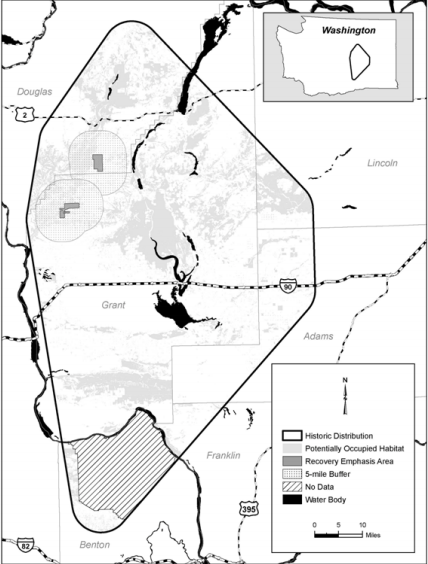
Geographic Distribution of the Columbia Basin
Pygmy Rabbit (Source: USFW Recovery Plan)

Where does it live?

Pygmy rabbits were historically found throughout the western and northwestern states of the United States. The Columbia Basin itself is located in the Pacific Northwest, stretching from northern Oregon through central Washington and up to British Columbia, Canada. The Columbia Basin population of the pygmy rabbit has existed for over 10,000 years as a distinct population from the other pygmy rabbit populations surrounding it. Analysis has shown that the population is genetically different from other pygmy rabbit populations in the area.

Pygmy rabbits were first found in central Idaho in the 1890s by a naturalist. In the early 1900s, they were thought to be rare in the Columbia Basin, and by mid-century, they were thought to be extirpated from the Columbia Basin. In the 1980s, biologists found 5 small subpopulations in a county in central Washington. After the five subpopulations were found, they, along with a subpopulation found in 1997, started to decline. By 2001, five of the six found subpopulations were extirpated.

How was it listed?

The pygmy rabbit was listed as threatened in 1990 and then relisted as endangered in 1993 by the state of Washington. The distinct population found in the Columbia Basin was first federally listed as endangered (under an emergency rule) in 2001, and was fully listed as endangered in 2003. The Washington Department of Fish and Wildlife released an initial recovery plan in 1995, with updated recovery plans released in 2001, 2003, and 2014.

Why are they endangered?

The Columbia Basin population of pygmy rabbits was listed due to a number of threats:
Habitat Fragmentation: One of the major threats to the pygmy rabbit’s survival is the continued destruction and fragmentation of their habitat. The sagebrush that pygmy rabbits rely on is routinely removed from the area by humans developing the land for both urban and rural purposes, and approximately 60% of the shrubland in the area has been converted. As a result, pygmy rabbits have less habitat on which they can survive.

Pygmy rabbits rely on sagebrush for food and cover.
(Source: Washington Dept. of Fish and Wildlife)
Overutilization for Recreational and Scientific Activities: The pygmy rabbit can be hard to distinguish from cottontail rabbits, which are often hunted. Hunters are also not denied access to areas where the Columbia Basin pygmy rabbit lives. As a result, pygmy rabbits can sometimes be hunted accidentally. A small number of pygmy rabbits also die due to capture and recapture related reasons.

Disease and Predation: Although severe epidemics of disease have not been reported among pygmy rabbit subpopulations in the Columbia Basin, both plague and tularemia episodes have occurred within the population. Skeletal abnormalities also have been shown to occur in the population, and possibly developed due to inbreeding. Predation by many terrestrial and avian predators also hinders the population’s survival rate.

Other Factors: The population’s small size makes it more susceptible to being extirpated by random environmental changes or changes in food supply. The initial group of purebred Columbia Basin pygmy rabbits had low genetic diversity, adding to their high susceptibility to disease and the likelihood that characteristics such as skeletal abnormalities and a low reproductive rate would spread to the whole population.

Recovery Plan

The recovery plan for the Columbia Basin population of pygmy rabbits’ goal is to reclassify the population as “threatened” from “endangered” and ultimately to delist the population entirely. The plan lists seven actions that aim to increase the population’s survival rate: captive breeding, genetics, reintroduction, predator control, survey and monitoring, stakeholder involvement, and public awareness.
The Washington Department Fish and Wildlife’s captive breeding and reintroduction program was established in 2001. To begin, sixteen pygmy rabbits were captured from the wild and seven were sent to re-breeding facilities at the Oregon Zoo. In 2007, 20 rabbits from the captive breeding program were re-released into the wild, but the reintroduction failed due to high mortality rates, and none of the population lived to 2008. Captive breeding at the Oregon Zoo was discontinued in 2012, and the captively bred population was released into the wild and is faring much better than the 2007 population. Populations are released on sites owned and managed by the Washington Department of Fish and Wildlife.
The Washington Department of Fish and Wildlife also launched an intercross breeding program, attempting to increase the population by cross-breeding Columbia Basin pygmy rabbits with Idaho pygmy rabbits. Intercross breeding also increases genetic diversity within the population, which would reduce some of the adverse health effects caused by inbreeding. The intercross population has had higher reproductive rates, as well as better immunity to disease, than the purebred rabbit population.
Predator control, such as removing artificial food sources and perches for predators, was also undergone at sites occupied by pygmy rabbits. The Washington Department of Fish and Wildlife monitors pygmy rabbits in the wild through three intensive survey methods, and provides incentives to private landowners that take steps towards protecting the pygmy rabbit on their land. Finally, the Oregon Zoo and other partners take part in promoting public awareness of the pygmy rabbit’s situation.


What can you do? The Washington Department of Fish and Wildlife has worked to increase the survival of the Columbia Basin population of pygmy rabbits. By donating to it, you can support efforts to reintroduce pygmy rabbits into the wild and further their recovery. Clicking here will allow you to donate to a program run by the department that works to increase youth awareness of wildlife and endangered species, including the pygmy rabbit.


Works Cited:
U.S. Fish and Wildlife Service. Recovery Plan for the Columbia Basin Distinct Population Segment of the Pygmy Rabbit (Brachylagus idahoensis). 2012.
"Pygmy Rabbits." Western Watersheds Project. Western Watersheds Project, n.d. Web. 2 Dec. 2015.
Media Sources:


Wednesday, December 2, 2015

The Florida Manatee by Ryan O'Neill


The Florida Manatee

By: Ryan O'Neill
           When I was a kid my family took a trip to the Key West in Florida.  All that me and my brothers wanted to do was surf on the awesome, coconut filled beaches.  After hours upon hours spent in the water, we started to see dark spots in the water that we immediately thought were sharks.  However, once we sped out of the water and asked the locals on the shore what they were, they told us not to worry, and they were just lovable manatees.  When we got home to California we decided to go to Sea World to see what we were in the water with.  After learning about these awesome animals, my heart melted after hearing about the danger they have been in.

What Are They?

Image result for florida manatee
            Manatees are massive animals with dark grey and wrinkled skin.  they have paddle-like forelimbs and a horizontally flattened tail.  Adults average about 9.8 ft. in length and typically weigh 2,200 lbs.  Manatees occur primarily in Florida and Georgia, but individuals can range as far north as Rhode Island.  Florida manatees have a low level of genetic diversity.  The record indicates that manatees probably are almost as geographically widespread today as they were historically; however, today they appear to be less abundant in many regions.

What is Their Listing?

Image result for florida manatee           
 Manatees were listed as endangered in 1967 and received federal protection with the passage of the ESA in 1973.  However their recovery plan was updated in 2001.  When they were listed, a critical habitat was designated in Florida.  This was one of the first ESA designations of critical habitat for an endangered species and the first for an endangered marine mammal.


Why Are They Endangered?

Image result for florida manatee injured
            Manatees became endangered as they were hunted by pre-Columbian societies for reasons that are still unclear.  After Spanish occupation, Florida’s human population increased, and manatees were taken in greater numbers.  Also, Commercial and subsistence hunting, particularly in the 1800s, ended up reducing the population significantly.  In 1893, the State of Florida passed legislation prohibiting the killing of manatees.  Today manatees face many threats.  Collisions with watercraft account for an average of 24 percent of known manatee deaths in Florida. Also, deaths because of water control structures and navigational locks represent 4% of known deaths. The future of the current system of warm-water refuges for manatees is uncertain as deregulation of the power industry in Florida occurs, and if minimum flows and levels are not established and maintained for the natural springs on which many manatees depend, could significantly impact their population and habitat.  There are also threats to habitat caused by coastal development throughout Florida.  There are also threats from natural events such as red tide and cold events.

How They Can Be Recovered?

Image result for florida manatee happy            In order to remove the Florida manatee from the List of Endangered and Threatened Wildlife (delisting).  We need to  Reduce or remove threats to the manatee habitat, as well as remove threats from manmade influences by implementing federal, state or local regulations that maintain spring flows, such as protecting warm-water refuge sites.  Also, it is essential to reduce or remove unauthorized human caused “take.”  If this were to occur over time, the qualifications for delisting will be: achieving certain population standards in each of the four regions 10 years after reclassification: statistics confirming that the adult survival rate is 90% or greater, and proof that annual rate of population growth is equal to or greater than zero.
Sites/ How You Can Get Involved